
Visiting the HSV Museum
Hamburger Sport-Verein (HSV) return to the Bundesliga for 2025/26 after a seven-year absence. For any keen fan of German football, you must pay it a visit.

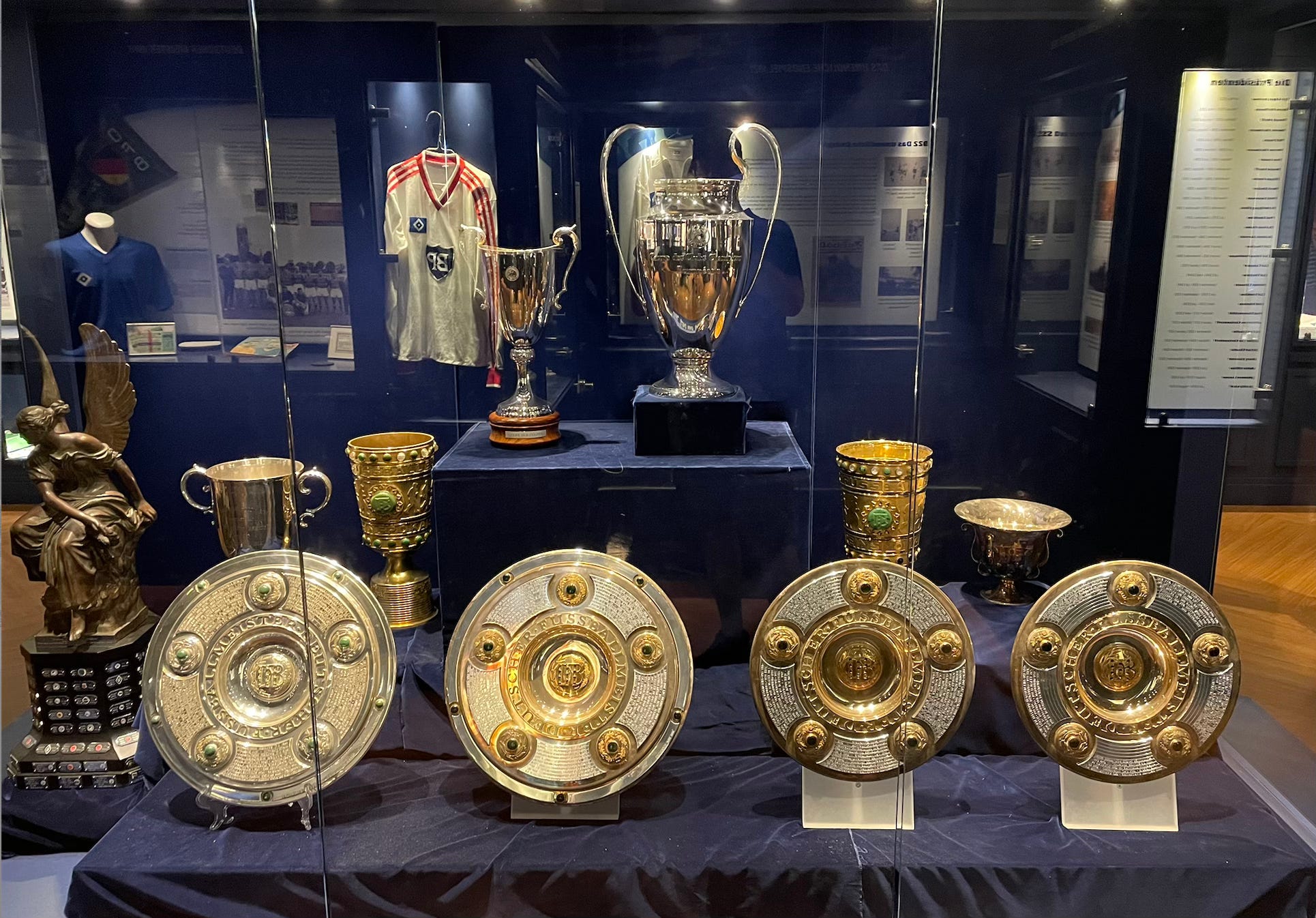
HSV’s impressive trophy room [Photo: Chris Lee/Outside Write]
I have been to HSV’s Volksparkstadion before, way back in 2012, when Son Heung-min and Rafael Van der Vaart were in the Hamburg side for a feisty Nordderby with Werder Bremen. However, when I returned in the summer of 2025 for a friendly between Hamburg’s third club, Altona 93, and my former local side Dulwich Hamlet, I decided to visit the HSV Museum.
Bring your walking shoes if you choose to visit HSV. It’s just over 1.5km to walk from the nearest S-Bahn station, Stellingen, to the Volksparkstadion. Aim for the Uwe-Seeler-Allee on the north side of the stadium, and it’s here that you will find the HSV Museum and club shop.
Outside the ground, you’ll pass a giant foot and ankle, with a small set of foot- and handprints of famous former HSV players and staff, including Kevin Keegan, Gunter Netzer, and legendary coach, Ernst Happel.
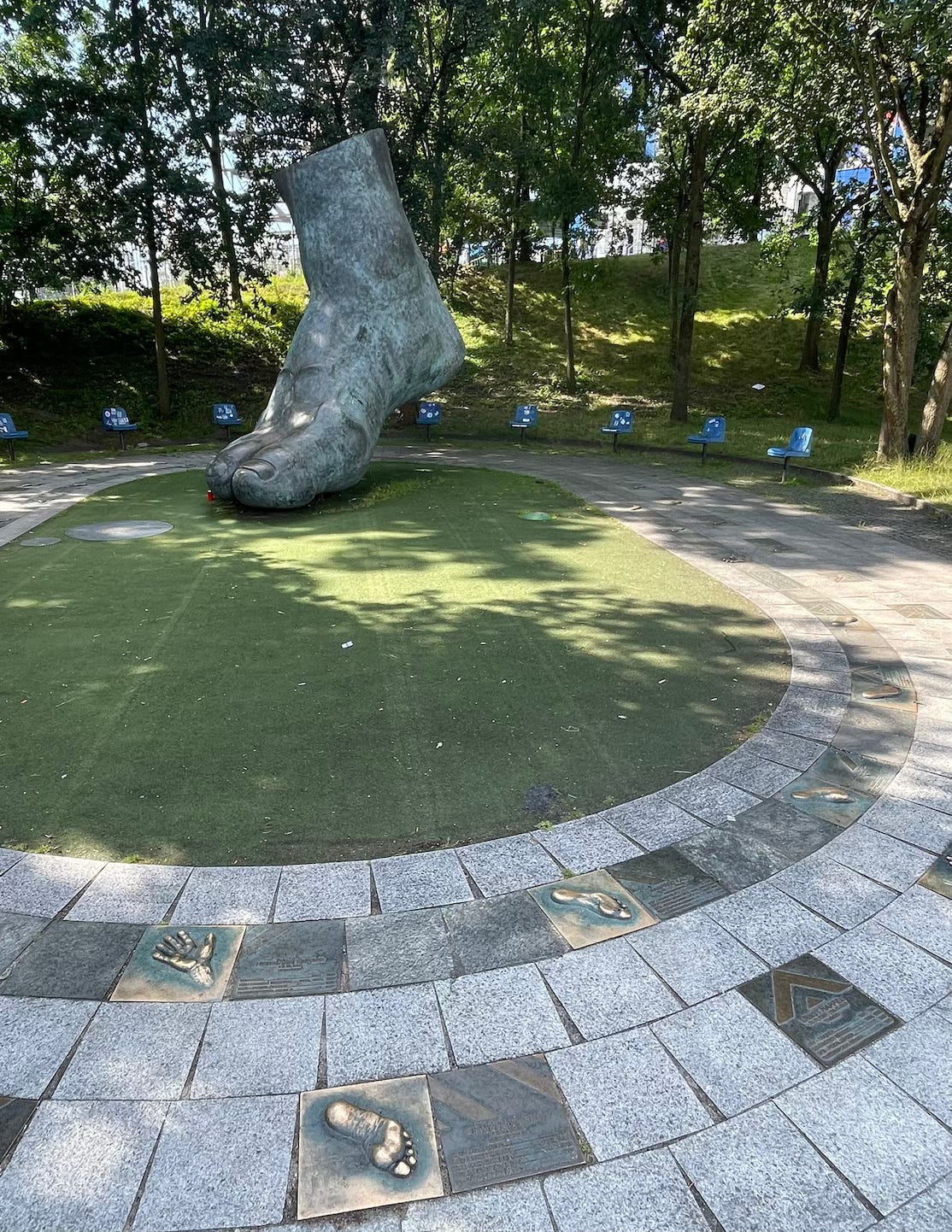
A unique way to celebrate HSV’s legends on the approach to the Volksparkstadion [Photo: Chris Lee/Outside Write]
The tour and museum combo costs just €12, but the museum on its own is also real value at just €6, which is what I did as I was on a tight schedule. The man at the reception spoke excellent English and had even visited Loftus Road, so kudos to him.
Hamburger SV’s roots
HSV can trace its origins back to one of the oldest clubs in German football, Sport-Club Germania Hamburg, founded on 29 Sept 1887, which is the date HSV fans celebrate as the club’s birthday. The current iteration, as Hamburger Sport-Verein (Hamburg Sport Club), was created in 1919 after the First World War, when SC Germania clubbed together with Hamburger Fußball Club (HFC) – a fellow founder of the Deutscher Fußball-Bund (DFB – the German FA) – and FC Falke von 1906.
Given that both Germania and HFC played in blue, white and black, these colours were carried over into the crest of the new entity, Hamburger SV. The club adopted red shorts on account of it being the colour of the Hamburg flag and soon became known as the Rothosen (Red Shorts).
The museum covers the early years, including a visit by the famous English amateur touring side, Corinthian FC, who left a trophy after playing HSV in 1925. There’s a model of the club’s original Stadion am Rothenbaum, where HSV started to pick up its first silverware.
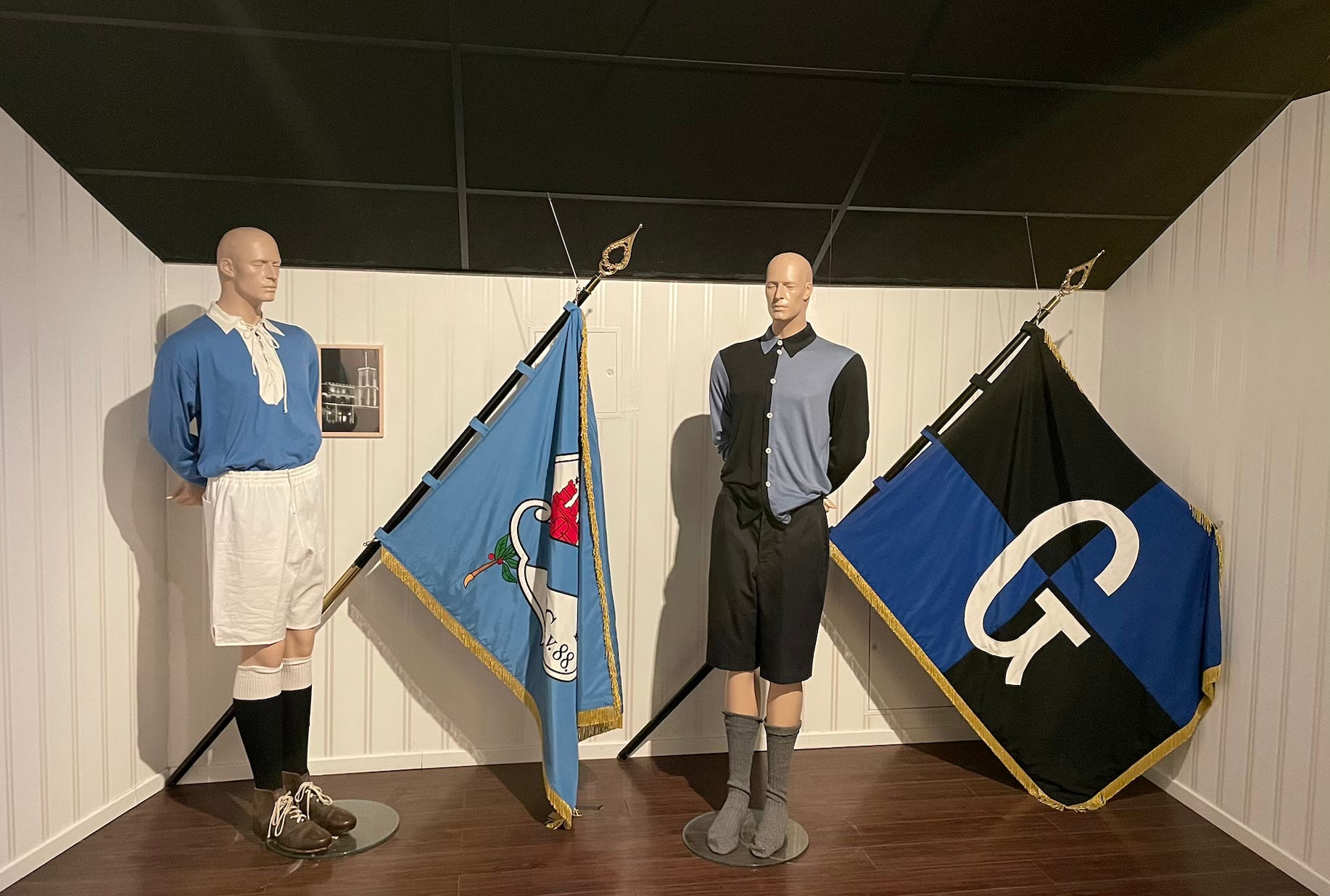
HSV were formed out of a merger of three clubs in 1919, two are shown here [Photo: Chris Lee/Outside Write]
A brief modern history of HSV
The city of Hamburg was bombed heavily during World War II, and Germany was divided. Hamburg was in West Germany, so the club was placed in the Oberliga Nord. In 1953, striker Uwe Seeler burst onto the scene. He would go on to become the club’s leading scorer and there is plenty of footage of him in the cinema reel of the club’s history. I’d heard the name but never seen him in action. He looks like a very modern centre-forward, great in the air.
Hamburger SV were involved in the first season of the new nationwide league, the Bundesliga, in 1963 and marked the occasion by moving to the Volksparkstadion. The multi-sports stadium had been built a decade earlier using many repurposed materials salvaged from bomb sites in Hamburg. HSV also secured its first DFB-Pokal (German FA Cup) in 1963 with a 3-0 win over Dortmund.
The Volksparkstadion hosted matches at the 1974 World Cup, including the famous encounter between West and East Germany, which resulted in a win for the communist GDR side by 1-0 thanks to a goal from 1.FC Magdeburg’s Jürgen Sparwasser. This is the period when HSV started to kick on and entered its golden era, winning its second DFB-Pokal in 1976, followed by the European Cup-Winners’ Cup in 1977. With England and former Liverpool star Kevin Keegan on board, HSV secured their first Bundesliga title in 1979.
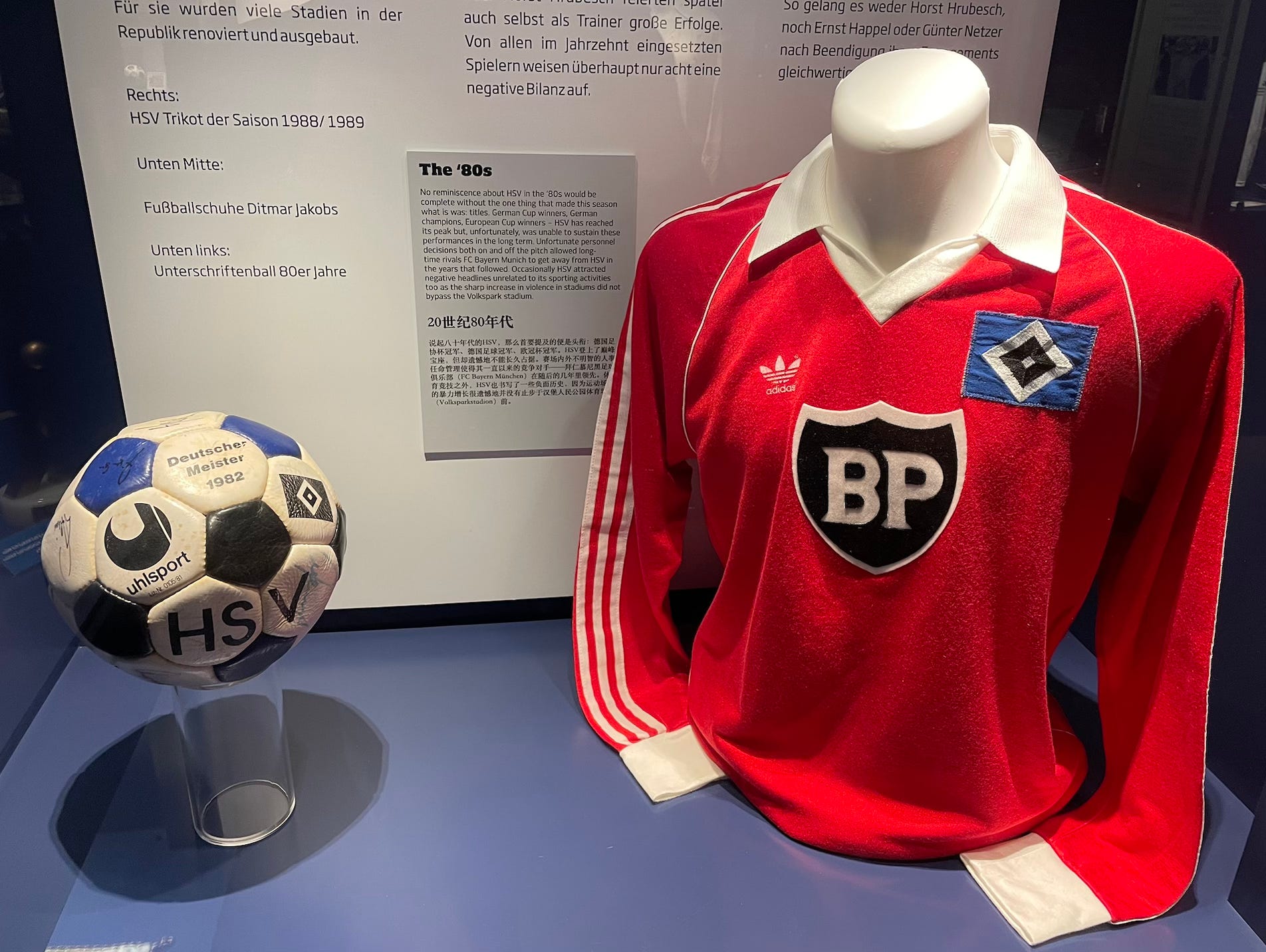
HSV’s players have donned some banging shirts over the years [Photo: Chris Lee/Outside Write]
The club fell 1-0 to Nottingham Forest in the final of the following season’s European Cup but, under Ernst Happel, won back-to-back championships and the European Cup in 1983, beating Juventus 1-0 in Athens. The trophies from this era are proudly on display in the largest room of the exhibition, surrounded by cabinets featuring some of the many great shirts that HSV wore in the 1970s and ‘80s.
HSV were the last of the original Bundesliga founding clubs to be relegated when they descended into 2.Bundesliga after a terrible 2017/18 season.
Other curios in the HSV Museum include a spectacular kutte (cut), a denim jacket typical of German football fans that is customised with club badges and patches. There are gifts from visiting clubs, including a pendant from Fulham and a model ship from Benfica. HSV also dedicates a few cabinets to confronting the National Socialist (Nazi) era and how that impacted the club.
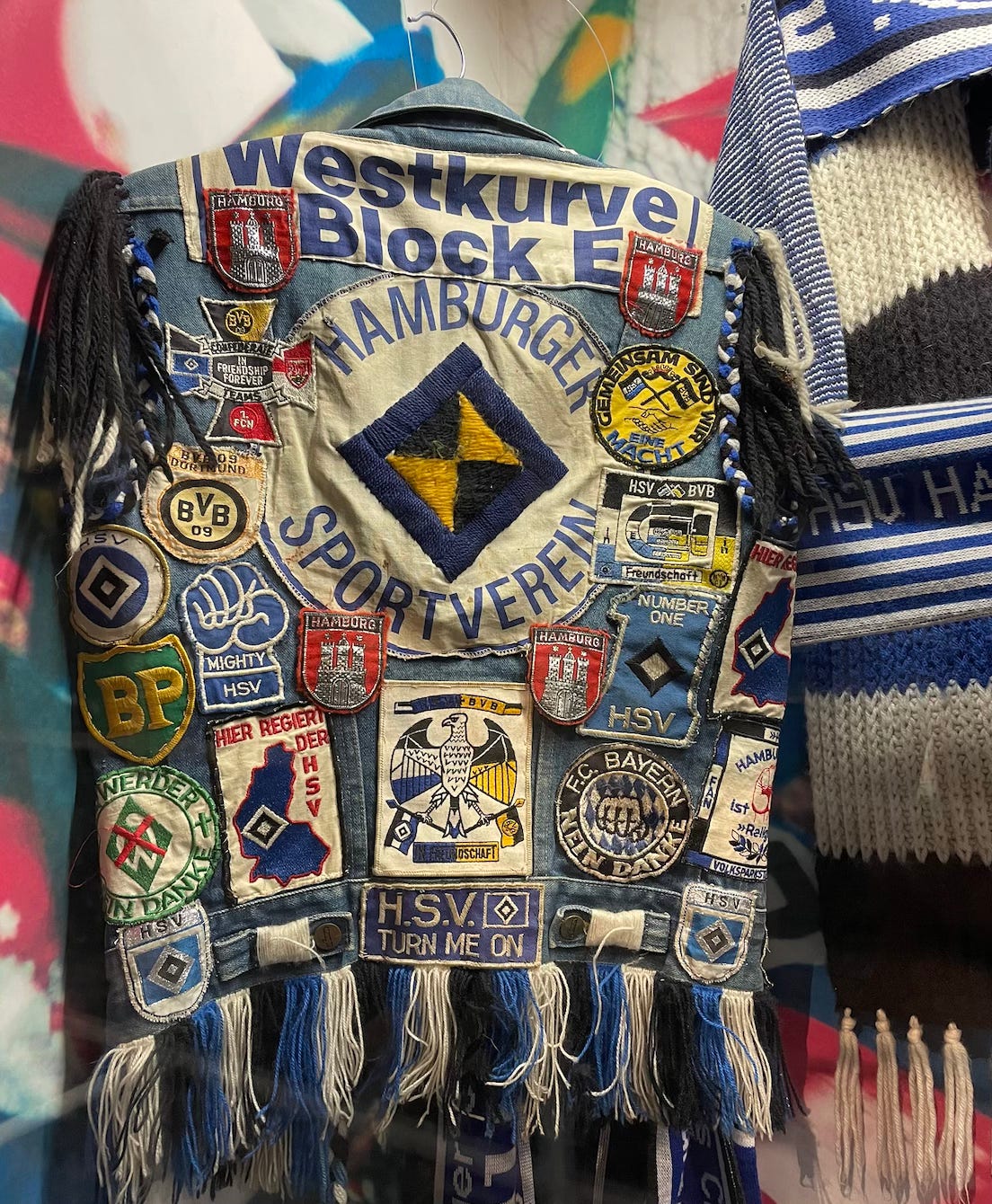
The famous German ‘kutte’, biker-style denim jackets that fans customise to their club [Photo: Chris Lee/Outside Write]
All in all, it’s one of the best value football museums you could wish to visit. HSV mark their history with pride and have created an engaging space that flows well and celebrates the club’s successes in an informative way.
How to get to the HSV Museum, Volksparkstadion
The nearest S-Bahn station is Stellingen, which includes a 1.5km walk or cycle through parkland that skirts an industrial estate and passes over a dual carriageway. It’s not the prettiest approach to a ground, but there are plenty of club stickers and graffiti to photograph on the way.